
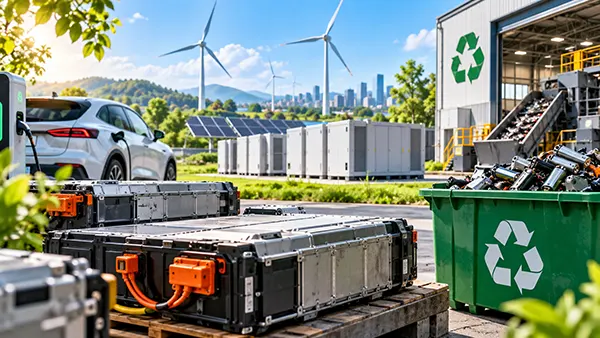
Second-Hand Battery Market in 2026: Investment Opportunities in Reuse and Recycling
The second-hand battery market is moving from a small specialist niche into a recognisable part of the wider energy and mobility economy. The scale behind that shift is already substantial: the International Energy Agency reports that global electric-vehicle battery deployment reached about 1.2 TWh in 2025, almost 30% more than a year earlier, while global electric-car sales exceeded 20 million. Yet the investment case in 2026 is not simply a story of more electric cars producing more waste. Most recent EV batteries are still in service, new battery prices remain competitive, chemistries are changing, and the value of a used pack can differ sharply depending on its condition, location and next use. For investors, the most relevant opportunities therefore sit across a chain that includes collection, diagnostics, repair, repurposing, stationary storage and materials recovery rather than in one single end-of-life business.
Why Second-Hand Batteries Are Becoming a Distinct Investment Market
The first reason is scale. Electric cars accounted for roughly one quarter of global new-car sales in 2025, creating a rapidly expanding stock of batteries that will eventually move through second-hand vehicle markets, repair networks, second-life applications and recycling. The IEA estimates that EVs represented more than 70% of global battery deployment in 2025, with light-duty vehicles responsible for most EV battery demand. This matters because a battery does not lose all economic value when a car changes owner or when a pack no longer meets an automotive requirement. Depending on its state of health, it may remain inside a used vehicle, be repaired with replacement modules, be refurbished for another vehicle, be repurposed for stationary storage or, if further use is unsafe or uneconomic, be sent for recycling. Each route has different margins, capital needs and risk.
The second reason is the timing mismatch between installed battery stock and actual recycling supply. According to the IEA’s 2026 analysis, the rapid increase in lithium-ion battery deployment since 2020 has not yet produced a comparable flow of end-of-life EV and stationary-storage batteries. The agency estimates a structural lag of roughly 15 years between the growth of battery deployment and the point at which similar volumes reach end of life, with production scrap expected to remain an important source of recycling feedstock until end-of-life batteries become dominant in the mid-2030s. This is a crucial investment distinction. A recycling plant may look attractive on the basis of future EV numbers, but its economics in the next several years depend on how much material it can actually secure and process. Long-term supply agreements can therefore be more valuable than nameplate processing capacity alone.
The third reason is that the price signal for used batteries is changing. The IEA notes that prices for used EV batteries have fallen sharply in Europe and North America, even while some critical-mineral prices strengthened during the second half of 2025. That divergence suggests that a used pack may increasingly be valued according to what a downstream buyer can earn from repair or second-life use rather than simply according to the metals inside it. At the same time, average new battery prices fell by about 8% in 2025, increasing competitive pressure on second-life products. For investors, this creates a more selective market. A cheap used battery is not automatically a bargain, but falling acquisition prices can improve margins for businesses that have low testing costs, reliable refurbishment processes and customers willing to accept a second-life product with clearly defined performance and warranty terms.
Where the Supply of Used Batteries Is Coming From
Used batteries reach the market through several channels, and those channels do not carry the same risk. Accident-damaged vehicles can provide packs or modules long before the battery reaches normal age-related retirement, while warranty replacements can release batteries that still have substantial usable capacity. Fleet operators may replace vehicles on a fixed commercial cycle, creating predictable batches of similar packs. Battery and vehicle factories also generate production scrap, which remains an important recycling input in 2026 because large volumes of early-generation EV batteries have not yet reached true end of life. At the same time, used electric cars are increasingly resold into second and third ownership rather than dismantled. For an investor, this means that forecasts based only on original vehicle sales can overstate near-term local feedstock because many batteries stay on the road or move to another country inside the vehicle.
Condition is the decisive filter between reuse and recycling. A common reference point is that an EV battery may be retired from demanding vehicle service when it has around 70% to 80% of its original capacity, but that figure should not be treated as a universal retirement rule. Remaining value depends on chemistry, pack design, temperature history, charging behaviour, cell balance, physical damage and the duty cycle required in the next application. Two packs showing the same headline state-of-health percentage can therefore have very different future lives. This makes diagnostics a commercial function rather than a minor technical check. Businesses able to test batteries quickly, identify weak modules, estimate remaining useful life and assign each pack to the highest-value safe route can capture value before the battery reaches either a second-life integrator or a recycler.
Chemistry is also reshaping supply economics. Lithium iron phosphate, or LFP, accounted for more than 55% of global EV battery deployment in 2025, according to the IEA. LFP generally contains less valuable recoverable metal than nickel-rich chemistries because it does not rely on nickel or cobalt in the cathode, which reduces the commodity value available to a recycler. At the same time, its widespread use means increasing future volumes for both reuse and recycling. Geography adds another layer. China hosts more than 85% of global battery recycling capacity, while companies in Europe and North America are still building local collection and processing chains. That combination favours investors who focus on access to material, regional logistics, safe storage and reliable grading rather than assuming that processing technology by itself creates a durable competitive advantage.
Investment Opportunities in Reuse and Second-Life Applications
The highest-value route for a used battery is often the one that keeps the greatest amount of the original product working. If a pack can remain in a vehicle after repair or refurbishment, that may preserve more economic value than dismantling it immediately. When automotive use is no longer suitable, stationary storage can become the next option. The US Department of Energy notes that EV packs retired at around 70% to 80% of original capacity may still have useful service potential in stationary applications. In practical terms, this can create investment opportunities for specialists that source batteries from fleets, insurers, dismantlers and vehicle manufacturers, then test and rebuild them into products with a defined operating window. The business case is strongest when incoming batteries are relatively uniform, their history is known and the repurposer has a clear buyer before spending heavily on conversion.
Stationary second-life systems can serve commercial solar installations, peak-demand reduction, backup power, microgrids and charging sites where storage helps reduce the load placed on a local grid connection. These uses can tolerate lower energy density better than a vehicle because weight and volume are usually less restrictive. However, second life should not be treated as an automatic low-cost substitute for a new battery. A repurposer must pay for collection, transport, electrical isolation, testing, disassembly, reconfiguration, enclosures, control equipment, certification, installation and warranty support. Fire-safety requirements and insurance conditions can also affect project economics. If those costs are high, a new LFP system with a long factory warranty may be the more competitive choice, especially after the continued decline in new battery prices.
For that reason, some of the more defensible opportunities in 2026 are businesses that solve a bottleneck rather than owning every stage of the chain. Independent testing and grading services can earn revenue from several downstream routes. Refurbishment specialists can focus on particular vehicle families and build repeatable repair processes instead of handling every battery design. Logistics companies can specialise in compliant transport and temporary storage of high-voltage batteries. Second-life integrators can secure supply first and build storage projects only when a buyer, site and warranty structure are already defined. There is also room for financing models in which battery systems are leased or paid for through contracted storage services, but such structures work only when performance data are credible and replacement obligations are fully priced. The key source of value is disciplined matching of each battery to the use that can pay most for its remaining life.
Testing, Grading and Stationary Storage as Value-Creation Points
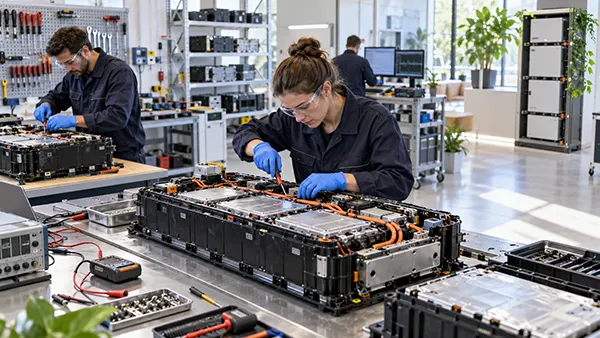
Testing is likely to become one of the most important value-creation points because the second-hand market suffers from information asymmetry. Sellers often know the vehicle history but not the battery’s future performance, while buyers need evidence that a pack can deliver a specified level of capacity and power for several more years. A commercially useful grading process therefore combines available operating history with physical inspection and controlled testing, then converts the result into a simple risk category that a buyer, insurer or lender can understand. The technical work can be sophisticated behind the scenes, but the product offered to the market should be straightforward: verified condition, expected performance, known exclusions and a clear warranty. Companies that can standardise this process across large volumes may reduce transaction costs and make second-hand batteries easier to finance.
Europe is also moving towards better battery data. Under the EU Batteries Regulation, from 18 February 2027 electric-vehicle batteries, light-means-of-transport batteries and industrial batteries above 2 kWh placed on the EU market will need a digital battery passport. European Commission guidance published in August 2026 brings together 71 relevant data points, while the digital product passport registry became operational in July 2026. Depending on access rights, passport information can cover battery identity, composition, performance and durability, state of health, status changes and information relevant to dismantling, repair, reuse and recycling. For investors, the important point is not the database itself but the reduction in uncertainty. Better standardised data can support quicker valuation, more consistent grading and lower due-diligence costs for businesses handling large numbers of used packs.
Stationary-storage investments still require conservative underwriting even when battery data improve. A project should identify exactly where the batteries come from, how similar they are, who is responsible for testing and refurbishment, what happens when individual modules fail, and who carries the cost of early replacement. It should also compare second-life equipment with the current price of new alternatives rather than with historical battery prices. The IEA reports that average battery prices declined by 8% in 2025 and that LFP packs were more than 40% cheaper per kWh on average than NMC alternatives. That price pressure can quickly erase the apparent discount of a used battery if repurposing is labour-intensive. Second-life storage is therefore most attractive where acquisition costs are low, battery batches are predictable, conversion is standardised and the customer values a lower-cost or lower-resource solution without requiring the performance profile of a new automotive-grade pack.
Recycling Economics, Regulation and the Main Risks for Investors
Recycling remains essential to the long-term battery economy, but its 2026 investment profile is more complicated than headline growth rates suggest. Current recycling feedstock is still heavily supported by manufacturing scrap, while most EV batteries sold during the recent surge in electric-car adoption remain in use. The IEA warns that recycling capacity is already high relative to available feedstock in many markets, which raises the risk of low plant utilisation and aggressive competition for material. Investors should therefore separate the different stages of recycling. Collection, discharge, dismantling and pre-processing create a concentrated intermediate material commonly known as black mass, while later refining stages recover lithium, nickel, cobalt, copper and other materials. A company can be strong in one stage without being competitive in the whole chain, and integration only adds value when each additional step has sufficient volume and a credible customer for its output.
Battery chemistry is a second major risk to recycling returns. NMC and related nickel-rich batteries contain metals that can provide meaningful recovered value, whereas LFP has a lower commodity value because it lacks nickel and cobalt in the cathode. With LFP now representing more than half of global EV battery deployment, recyclers cannot assume that future feedstock will have the same revenue per tonne as older chemistry mixes. The IEA points to toll-based recycling as one response: instead of relying primarily on profit from selling recovered materials, the recycler is paid to process batteries while the customer retains ownership of the recycled output. This can make revenue less dependent on metal prices and may suit lower-value chemistries. Growing interest in sodium-ion batteries reinforces the same lesson. A recycling investment should be able to handle changes in chemistry without depending on one favourable commodity mix for its entire return.
Regulation provides a stronger long-term demand signal, particularly in Europe. Under the EU Batteries Regulation, lithium-based waste batteries were required to reach at least 65% recycling efficiency by average weight by the end of 2025. By the end of 2027, material-recovery targets rise to 90% for cobalt, copper, lead and nickel and 50% for lithium. From August 2031, specified EV, industrial and starter batteries containing these materials are due to meet minimum recycled-content shares of 16% for cobalt, 85% for lead, 6% for lithium and 6% for nickel. The EU Critical Raw Materials Act also sets a 2030 benchmark under which Union recycling capacity should be capable of producing at least 25% of annual EU consumption of strategic raw materials. Separately, the battery due-diligence obligations originally scheduled for 2025 were postponed to 18 August 2027, giving affected businesses more preparation time. These rules support demand for high-quality secondary materials, but they do not remove commercial risks such as feedstock shortages, weak utilisation or poor operating discipline.
How to Assess a Battery Circular-Economy Investment in 2026
The first due-diligence question should be where the batteries will come from and under what contractual terms. A recycling or repurposing business needs evidence of recurring supply from manufacturers, fleets, insurers, repair networks, dismantlers or waste-management operators, not just a forecast of future EV retirements. Contracts should specify ownership, battery condition, transport responsibility, contamination limits, chemistry information and what happens when material fails acceptance tests. Investors should also understand whether used vehicles are likely to be exported rather than dismantled locally, because that can shift future battery supply to another region. For second-life projects, the same principle applies at pack level: a stable batch of known batteries is generally easier to test, warrant and finance than a mixed stream bought opportunistically from many small sellers.
The second question is whether the unit economics remain viable under less favourable assumptions. For reuse, that means modelling lower-than-expected usable capacity, higher testing costs, module failures, warranty claims and further declines in new battery prices. For recycling, it means testing returns at lower metal prices, different chemistry mixes, lower recovery yields and weaker plant utilisation. Transport, fire protection, insurance, permitting, energy use, labour, working capital and safe disposal of non-recoverable fractions should be included rather than treated as minor overhead. Large processing facilities are particularly sensitive to utilisation because fixed costs continue even when feedstock is scarce. A credible investment case should therefore show how the business earns money in a weak commodity environment and how it protects margins if competition pushes up the price paid for used batteries or production scrap.
The strongest opportunities in 2026 are likely to be those built around control of feedstock, trustworthy battery data and flexibility between reuse and recycling. A company that can repair a viable pack, repurpose a suitable one and direct only the remainder to materials recovery has more options than a business that depends on a single end route. Partnerships with vehicle manufacturers, fleet owners, insurers, dismantlers, storage developers and refiners can also reduce the need to own every asset in the chain. Europe’s move towards battery passports and recycled-content requirements should gradually improve traceability and support demand for secondary materials, but the near-term winners will still be determined by operational execution. Investors should favour businesses that can prove where batteries come from, measure what remains in them, place them in the highest-value safe use and remain profitable when battery and metal prices move against the base case.