
Investing in Europe’s Defence Industry in 2026: Which Companies Could Benefit from the €1.5 Billion EDIP?
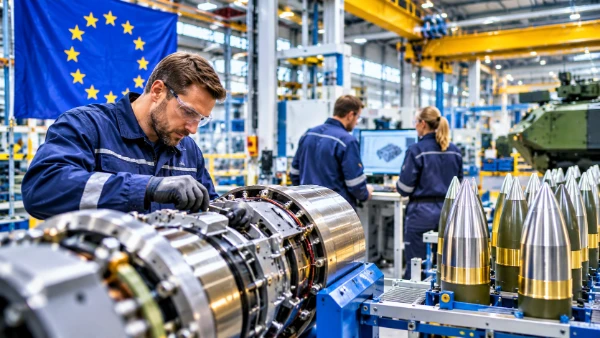
Europe’s defence industry is attracting increasing investor attention as governments expand military budgets, rebuild ammunition reserves and seek greater independence in producing essential equipment. One important development is the European Defence Industry Programme (EDIP), which provides €1.5 billion to strengthen European and Ukrainian defence manufacturing. The European Commission approved its 2026–2027 work programme in March 2026, directing funding towards production capacity, joint purchasing and industrial cooperation. For investors, the central question is not simply which defence companies will receive public money. It is which businesses have the products, manufacturing capacity and financial strength to benefit from Europe’s longer-term security priorities. Rheinmetall, Leonardo, Thales, Saab and several specialist suppliers deserve attention, although the potential advantages differ substantially between them.
How the €1.5 Billion EDIP Programme Could Change Europe’s Defence Industry
The European Defence Industry Programme represents a shift in how the European Union supports military manufacturing. Traditionally, individual countries have purchased much of their equipment through separate national contracts, sometimes choosing different systems for similar tasks. This has created fragmented supply chains and made cooperation more expensive. EDIP encourages countries to coordinate purchases while helping manufacturers expand production of equipment that European armed forces urgently require. The Council of the EU formally adopted the programme in December 2025, and the European Commission approved the operational funding arrangements on 30 March 2026. Although the legislation covers 2025–2027, the adopted work programme concentrates its spending on 2026 and 2027.
The €1.5 billion allocation is divided between several priorities rather than distributed equally among defence manufacturers. More than €700 million is intended to strengthen industrial production, including ammunition, missiles, specialised electronic components and systems used to detect or counter drones. Another €325 million supports European Defence Projects of Common Interest, which are designed to address shared security needs. Joint equipment purchasing receives €240 million, while €100 million is allocated to investment support for smaller defence businesses through the FAST initiative. The programme also includes dedicated innovation funding, particularly for cooperation with Ukraine. These allocations show that Brussels is addressing both immediate shortages and longer-term industrial weaknesses.
EDIP should not be confused with Europe’s entire defence spending programme. Its €1.5 billion budget is relatively small compared with the annual military expenditure of European governments, and the money is spread across numerous activities. Its importance lies partly in encouraging national authorities and private manufacturers to invest alongside EU grants. Funding can make it easier to justify new factories, additional production lines or joint industrial projects. Nevertheless, a grant does not automatically translate into higher company profits. Manufacturers still need customers, workable contracts, reliable suppliers and sufficient demand to operate their expanded facilities over several years.
Where EDIP Funding Is Going and What Has Already Happened in 2026
One of EDIP’s most important elements is industrial reinforcement. Approximately €440 million is allocated to production projects involving EU and Norwegian industry, including energetic materials, defence electronics and manufacturing capacity for finished equipment. A further €260 million supports industrial cooperation involving Ukraine. Within this second allocation, €180 million targets missiles, ammunition and bombs, while €80 million concerns unmanned and counter-unmanned systems. The wider Ukraine Support Instrument has a €300 million allocation, including additional innovation initiatives. These figures are particularly relevant because they identify which industrial activities are eligible for support rather than suggesting that every defence business can claim funding.
The programme moved beyond planning during 2026. Its first industrial reinforcement call, focused on energetic components such as propellants and explosives, attracted 83 applications from businesses across 23 EU member states and Norway. On 14 October 2026, the European Commission announced €168.2 million for eight projects involving production facilities in 14 countries and Norway. According to the Commission, these projects are expected to mobilise €1.26 billion in industrial investment. This is a meaningful development: public funding is now associated with specific manufacturing projects rather than general political commitments. However, these awards must not be treated as evidence that every major listed defence contractor has received EDIP financing.
Further opportunities remain scheduled for 2027. The European Commission lists 16 February 2027 as the deadline for applications covering important electronic components, manufacturing capacity for defence equipment and certain Ukrainian industrial cooperation projects. Financial support for eligible industrial reinforcement projects can cover different proportions of costs depending on the relevant call, with some Ukraine-related measures offering particularly high funding rates. Investors should examine the published conditions before assuming a particular company qualifies. The official European Commission EDIP information page provides the applicable funding categories, deadlines and programme updates.
European Defence Companies That Could Benefit from EDIP
Germany’s Rheinmetall is among the clearest examples of a company whose existing operations correspond to EDIP’s industrial priorities. Its activities include artillery ammunition, military vehicles, weapons systems and important defence components. The company reported consolidated sales of approximately €9.9 billion for 2025, up 29%, while its own broader backlog measure reached €63.8 billion. These figures reflect considerable demand before any additional benefits from EDIP are considered. Rheinmetall’s ammunition manufacturing capabilities are particularly relevant because European countries need to increase production and maintain sufficient reserves. Expanding factories and improving supply chains could support further growth, but investors should distinguish existing national contracts from new EU-supported projects.
Italy’s Leonardo offers a different combination of opportunities. The company produces defence electronics, radar equipment, helicopters and other advanced military systems. Its technological capabilities are relevant to European air defence, surveillance and cooperation between armed forces. Leonardo reported €19.5 billion in revenue and €23.8 billion in new orders for 2025. By November 2026, its outlook had strengthened further: following its nine-month results, the group raised its full-year new-order guidance to approximately €29.5 billion, including the contribution from Iveco Defence Vehicles. This broad product range gives Leonardo exposure to several areas of European military investment, although not all of its businesses are directly connected to EDIP’s grant categories.
France’s Thales is particularly interesting for its work in radar, communications, electronic systems and air defence. Modern military equipment increasingly depends on these technologies because armed forces need to detect threats, share information securely and coordinate different weapons systems. Thales reported approximately €15.1 billion in defence orders during 2025, demonstrating strong underlying demand. EDIP’s emphasis on electronic components, common equipment standards and integrated defence capabilities fits several parts of the company’s business. However, the company also operates beyond the defence sector, so its overall financial results depend on more than European military procurement. An investor evaluating Thales should consider the performance of its individual divisions rather than relying on general expectations of higher defence expenditure.
Saab, BAE Systems and Specialist Suppliers in the European Defence Supply Chain
Sweden’s Saab is another important company to examine. Its products include surveillance radar, air defence equipment, guided weapons and military aircraft. These capabilities correspond to several of Europe’s identified defence needs, particularly the protection of airspace and responses to unmanned aircraft. Saab ended 2025 with an order backlog of approximately SEK 274.5 billion, supported by record annual order bookings of SEK 168.5 billion. Its continuing expansion during 2026 illustrates how military demand can translate into business growth. Saab could benefit from coordinated European procurement and industrial investment, but its financial prospects also depend on export contracts, production schedules and the ability to meet delivery commitments.
BAE Systems deserves consideration despite being headquartered in the United Kingdom, which is outside the EU. The company manufactures combat vehicles, naval systems, electronic equipment and ammunition-related products. It reported an order backlog of £83.6 billion at the end of 2025, providing substantial visibility over future activity. Its European operations and industrial partnerships may benefit from higher regional defence spending. Direct participation in EDIP-funded activities, however, is a separate question. Eligibility depends on the specific call, the location and control of participating businesses, and requirements concerning the origin of components. Investors should therefore avoid assuming that a British headquarters either guarantees or automatically prevents participation in every relevant project.
Smaller manufacturers may experience some of the most significant effects relative to their size. Europe’s largest defence groups depend on specialist suppliers of electronic components, propulsion materials, optical equipment, batteries and precision-engineered parts. Companies such as Norway’s Kongsberg Gruppen, Germany’s Hensoldt and Italy’s Avio have activities connected to areas receiving greater defence investment. Their commercial exposure differs: Kongsberg supplies missile and defence systems, Hensoldt specialises in sensors and radar, while Avio has propulsion-related expertise. None should be described as an automatic EDIP winner. More importantly, many smaller suppliers are privately owned or operate as divisions of larger businesses, limiting opportunities for direct stock-market investment. A useful company analysis therefore examines actual contracts, ownership structures and customer relationships.
How Investors Can Assess Opportunities and Risks in European Defence Stocks
The strongest investment opportunities are not necessarily found in companies with the largest military contracts. Investors need to consider how much additional revenue a business can generate, how profitable that revenue might be and whether expansion requires substantial expenditure. A manufacturer may announce a large order but receive payments gradually over several years while spending money upfront on factories, equipment and employees. This creates a distinction between an impressive order backlog and strong free cash flow. The relationship matters particularly in 2026, when several European defence businesses are expanding production. A company that increases sales without controlling costs may deliver weaker shareholder returns than anticipated.
Valuation is equally important. Rising defence budgets have increased interest in military contractors, and share prices may already reflect expectations of several years of growth. Investors buying after substantial price increases face the risk that good company results will still disappoint the market. Comparing price-to-earnings ratios, expected earnings growth, debt levels and free cash flow can help identify whether a valuation is justified. These measures should be considered alongside the quality of a company’s backlog and its dependence on a small number of government customers. A business with strong demand and a reasonable share price may offer a more balanced investment case than a faster-growing competitor whose future success is already fully reflected in its valuation.
Political decisions remain an unavoidable source of uncertainty. EDIP establishes funding opportunities, but future military purchases depend heavily on national budgets, procurement decisions and changing security priorities. Elections, negotiations between governments, industrial disagreements and delays in approving major contracts can affect expected revenue. Export restrictions may also prevent companies from entering particular markets, while shortages of skilled workers and specialised components can slow manufacturing. The risk is not limited to reduced military spending: even sustained demand can create problems when suppliers cannot deliver equipment quickly enough. Investors should consider different scenarios rather than treating every announced defence initiative as guaranteed future income.
What to Monitor in 2027 and How to Build a Balanced Investment View
The next stage of EDIP implementation will provide more concrete evidence about which businesses benefit. Investors should follow announcements of successful applications, new industrial partnerships and procurement agreements linked to specific equipment categories. The scheduled February 2027 funding deadlines are especially relevant for electronics and additional manufacturing projects. Progress on European Defence Projects of Common Interest also deserves attention because these initiatives may influence cooperation between manufacturers over several years. Importantly, the value of a project announcement should be assessed against the company’s existing revenue and order backlog. A €20 million grant may be significant for a specialist supplier but comparatively modest for a multinational defence contractor.
For investors considering a portfolio of European defence shares, diversification can reduce dependence on a single company or equipment category. Rheinmetall offers substantial exposure to ammunition and land systems; Leonardo and Thales provide opportunities associated with electronics, surveillance and integrated defence technology; Saab combines guided weapons and radar with other military products. BAE Systems and selected specialist manufacturers add different geographic and industrial exposures. These distinctions are useful, but holding several defence stocks does not remove sector-wide risks. All may respond similarly to changes in government spending, political expectations or investor sentiment. Broader diversification across unrelated industries remains important when managing investment risk.
Europe’s €1.5 billion EDIP programme is best understood as one part of a wider change in defence policy, not as a direct forecast of stock-market performance. The October 2026 funding decisions confirm that the initiative is supporting real industrial investment, while the remaining calls and cooperative projects create further opportunities. Rheinmetall, Leonardo, Thales and Saab have business activities closely connected to Europe’s defence priorities, but their prospects depend on contract execution, profitability and valuation as much as public spending. For investors assessing the sector in late 2026, the most useful approach is to follow confirmed orders and financial results, distinguish grants from commercial revenue, and judge each company on its own merits rather than assuming that higher defence expenditure guarantees investment returns.