
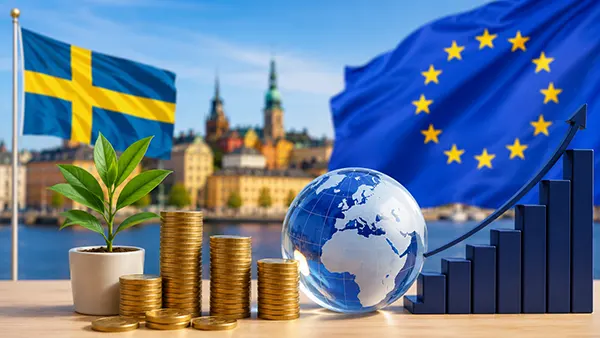
Savings and Investments Union: How the New EU Initiative Could Change Access to Funds, ETFs and Long-Term Investing in Sweden
The European Union is moving towards a more integrated capital market through its Savings and Investments Union (SIU), an initiative introduced to encourage citizens to invest more effectively while helping businesses gain better access to financing. Although Sweden already has one of Europe’s most mature retail investment markets, the initiative could still influence how Swedish residents access investment funds, exchange-traded funds (ETFs), pension products and cross-border financial services. Rather than replacing existing national regulations, the SIU seeks to remove unnecessary barriers between EU member states, making investment opportunities more accessible and competitive. For Swedish households, which already hold a significant proportion of their wealth in financial assets, the initiative may gradually expand product choice, reduce certain investment costs and improve transparency without changing the fundamentals of responsible investing.
What Is the Savings and Investments Union and Why Has the EU Introduced It?
The Savings and Investments Union was presented by the European Commission as part of its wider strategy to strengthen European capital markets and channel more private savings into productive investments. European households collectively hold trillions of euros in bank deposits, while many innovative businesses continue to rely heavily on bank lending rather than capital markets. By encouraging investment through regulated financial products, the EU aims to support economic growth, technological innovation and long-term competitiveness.
The initiative builds on earlier work carried out under the Capital Markets Union but introduces a broader focus on retail investors. Policymakers recognise that many citizens either invest very conservatively or avoid investing altogether because of limited financial knowledge, fragmented rules across member states or unnecessary administrative complexity. The SIU therefore focuses on improving access to investment opportunities rather than encouraging excessive risk-taking.
For Sweden, the proposal arrives in an environment where investing is already relatively common. Millions of Swedes own investment funds through pension schemes, Individual Savings Accounts (Investeringssparkonto, or ISK) or occupational pensions. Even so, European policymakers believe additional harmonisation could make cross-border investing more efficient while giving Swedish investors easier access to financial products available elsewhere within the European Union.
How the Initiative Differs from Previous EU Financial Reforms
Unlike earlier regulatory packages that concentrated mainly on financial institutions, the Savings and Investments Union places stronger emphasis on individual investors. The objective is not only to simplify capital flows between member states but also to ensure that ordinary households can participate more easily in long-term wealth creation through transparent and well-regulated investment products.
Another important distinction is the growing attention given to financial literacy. European institutions acknowledge that access alone is insufficient if consumers struggle to compare costs, understand investment risks or evaluate long-term returns. Future measures are therefore expected to promote clearer disclosures, more consistent investor information and educational initiatives across member states.
The initiative also seeks closer cooperation between national supervisory authorities. While Sweden’s Finansinspektionen will continue regulating the domestic financial sector, greater coordination with other European regulators could simplify the distribution of authorised investment products throughout the EU. This may reduce duplication for financial providers while maintaining investor protection standards that Swedish consumers already expect.
Potential Changes for Swedish Investors Using Funds and ETFs
Sweden already offers broad access to mutual funds and exchange-traded funds through banks, specialist investment firms and digital brokers. Nevertheless, the Savings and Investments Union may gradually make it easier for Swedish investors to compare and purchase investment products that are authorised in other EU countries. Increased market integration could encourage providers to compete more actively on management fees, product quality and investment strategies, ultimately giving consumers a wider selection.
ETFs are expected to receive particular attention as policymakers encourage efficient long-term investment solutions. Although ETFs have become increasingly popular among Swedish private investors over the past decade, their market share still remains smaller than that of traditional mutual funds. Greater harmonisation across Europe could improve access to both active and passive ETF products covering global equities, European companies, government bonds, corporate bonds, infrastructure and sustainable investment themes.
The initiative could also simplify administrative procedures for investment companies wishing to distribute their products across several EU countries. If fewer regulatory differences need to be addressed separately in every national market, investment managers may launch new funds more efficiently. Swedish investors would benefit from broader competition without sacrificing the investor protections established under existing European financial legislation.
How Costs, Transparency and Investor Protection Could Improve
One of the recurring concerns among European policymakers is the wide variation in investment costs across member states. The Savings and Investments Union encourages clearer fee disclosure so investors can understand the full cost of owning investment products before making decisions. More transparent pricing allows consumers to compare funds more effectively and identify products offering stronger long-term value.
Improved transparency extends beyond management fees. Investors may receive more consistent information regarding portfolio composition, historical performance, investment objectives and potential risks. Standardised reporting across the European Union would make comparisons between similar products considerably easier, particularly for individuals investing internationally through diversified portfolios.
Consumer protection remains a central principle throughout the initiative. Existing safeguards under regulations such as MiFID II and PRIIPs are expected to remain in place while future adjustments focus on simplifying disclosures rather than reducing regulatory oversight. Financial advisers and investment firms will continue assessing product suitability, ensuring recommendations remain aligned with an investor’s financial circumstances, objectives and risk tolerance.

Long-Term Investing, Retirement Planning and Future Opportunities
Perhaps the most significant long-term objective of the Savings and Investments Union is encouraging European households to build wealth over decades instead of relying primarily on savings accounts. While bank deposits provide security and liquidity, they often generate lower returns over long investment horizons than diversified portfolios containing shares, bonds and professionally managed funds. For Swedish investors, this philosophy aligns closely with existing pension investment practices, where long-term growth has traditionally played an important role.
The initiative may also support greater participation in retirement-focused investment products. Sweden already combines the public pension system with occupational pensions and voluntary private savings, but improved access to European investment solutions could provide additional flexibility for individuals wishing to supplement their retirement income. Products designed for gradual wealth accumulation over twenty or thirty years may become more visible as financial providers adapt to evolving European standards.
Another expected development is increased investment into sectors considered strategically important for Europe’s future economy. The European Commission has repeatedly identified digital technologies, renewable energy, advanced manufacturing, artificial intelligence, healthcare innovation and infrastructure as areas requiring substantial private capital. By encouraging households to participate through diversified investment vehicles, the initiative aims to strengthen both personal financial resilience and European economic competitiveness.
What Swedish Investors Should Consider Before the Reforms Take Full Effect
Although the Savings and Investments Union creates new opportunities, it does not remove the need for careful financial planning. Every investment carries risk, including the possibility of losing capital. Swedish investors should continue assessing their investment horizon, financial objectives and ability to tolerate market fluctuations before selecting funds or ETFs, regardless of how accessible these products become in the future.
Diversification is likely to remain one of the most effective approaches for long-term investing. Rather than concentrating assets within a single industry, country or financial product, investors generally reduce overall portfolio risk by spreading investments across different regions and asset classes. Low-cost index funds and broadly diversified ETFs will probably continue attracting attention because they provide wide market exposure while keeping ongoing expenses relatively modest.
The Savings and Investments Union represents an evolutionary rather than revolutionary change for Sweden’s investment landscape. Many practical measures will be introduced gradually over several years as European legislation develops and national authorities implement agreed reforms. For Swedish investors, the most noticeable effects are likely to include broader access to investment products, greater fee transparency, stronger competition between providers and a more integrated European investment market that supports informed, long-term financial decision-making.